
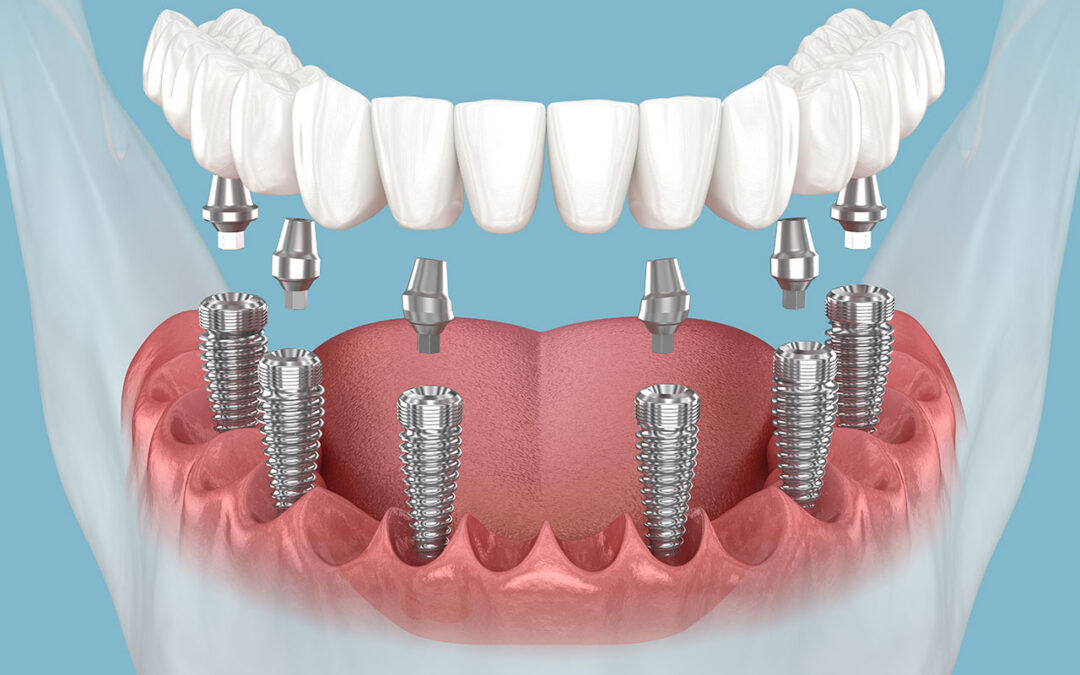
What if you could replace an entire row of missing teeth without needing a separate dental implant for every tooth? For patients dealing with extensive tooth loss, loose dentures, or severely damaged teeth, full-arch restoration can offer a more stable approach to rebuilding everyday function. All-on-X dental implants are designed to support a complete set of replacement teeth using a carefully planned number of implants.
At Red River Dental, we provide personalized All-on-X dental implants in East Grand Forks to help patients explore full-arch tooth replacement. Whether you are currently wearing conventional dentures or considering options for teeth that can no longer be preserved, understanding how All-on-X works can help you decide whether this restorative approach deserves consideration.
What Are All-on-X Dental Implants?
All-on-X is a full-arch tooth replacement approach that uses multiple dental implants to support a complete set of prosthetic teeth.
Rather than replacing each missing tooth with an individual implant, the dentist places a smaller number of implants in strategic positions within the jawbone. These implants provide the foundation for a full-arch restoration.
The letter X refers to the number of implants selected for the treatment plan. Common configurations use four, five, or six implants, although the appropriate number depends on the patient’s anatomy and restorative needs.
The implants are typically made from biocompatible materials designed to integrate with the surrounding bone over time.
Once the implants have sufficient stability and healing has progressed, they can support a custom-made restoration that replaces the visible teeth across the arch.
All-on-X dental implants are commonly considered for people who have lost most or all of their teeth in one jaw. They may also be an option when remaining teeth are extensively damaged and cannot be predictably restored.
How Is All-on-X Different From Traditional Dental Implants?
A traditional single-tooth implant replaces an individual missing tooth. The implant supports a restoration such as a crown without relying on neighboring natural teeth.
All-on-X dental implants use several strategically positioned implants to support an entire arch of replacement teeth.
This approach can reduce the number of implants required compared with replacing every missing tooth individually.
However, fewer implants do not necessarily mean simpler treatment. Full-arch rehabilitation requires careful evaluation of jawbone anatomy, bite relationships, implant positioning, and the design of the replacement teeth.
Another important distinction is that full-arch restorations must function as a coordinated unit. The dentist considers how the upper and lower teeth contact each other, how chewing forces are distributed, and how the restoration will be cleaned.
Patients interested in All-on-X should understand that both the surgical implants and the visible prosthetic teeth are essential parts of the treatment.
Benefits of All-on-X Dental Implants
All-on-X dental implants can provide meaningful advantages for suitable patients who need extensive tooth replacement.
- Full-arch replacement: A complete row of missing teeth can be restored using a coordinated implant-supported prosthesis.
- Improved stability: Implants anchor the restoration to the jaw rather than relying only on gum tissue.
- Better chewing support: A stable restoration may allow patients to manage a wider variety of foods compared with loose conventional dentures.
- Natural-looking appearance: Custom-designed teeth can be shaped and arranged to complement the patient’s facial features.
- Reduced denture movement: Implant support can minimize the shifting associated with some traditional removable dentures.
- Jawbone stimulation: Dental implants transfer chewing forces into the surrounding bone and may help reduce bone loss in the areas receiving stimulation.
- Personalized restoration: Treatment planning considers tooth position, bite function, appearance, and maintenance needs.
- Long-term treatment potential: With proper care and professional monitoring, implant-supported restorations can provide many years of function.
These benefits depend on successful implant integration, healthy supporting tissues, appropriate restoration design, and ongoing maintenance.
Who May Be a Candidate for All-on-X Dental Implants?
All-on-X dental implants may be appropriate for adults who have lost most or all of their teeth in one arch. They may also be considered when extensive dental damage makes preservation of the remaining teeth impractical.
However, tooth loss alone does not determine eligibility. The dentist must evaluate bone support, gum health, medical history, and the patient’s ability to maintain the finished restoration.
Patients with a history of gum disease may still qualify in selected cases, but active infection and inflammation generally require appropriate management before implant treatment.
Smoking and certain medical conditions can increase the risk of healing problems or implant complications. These factors should be discussed openly during the consultation.
Available bone volume is another important consideration. Some patients have sufficient bone for strategically positioned implants, while others may require additional procedures or a different treatment plan.
The dentist will also evaluate the relationship between the jaws and whether enough space exists for the planned prosthetic teeth.
Because full-arch treatment is highly individualized, a comprehensive evaluation is essential before determining candidacy.
What Happens During an All-on-X Consultation?
The consultation is an opportunity to discuss your dental concerns, treatment goals, and available restorative options.
Your dentist will examine the condition of any remaining teeth, assess the gums, and review your general health history.
Three-dimensional imaging may be used to evaluate jawbone anatomy and identify appropriate implant positions. This information helps the dental team plan treatment around important structures such as nerves and sinus spaces.
Next, the dentist considers the type of prosthetic restoration that may provide the best balance of function, appearance, and maintainability.
You may also discuss whether any existing teeth need to be removed and whether a temporary restoration could be provided during healing.
At Red River Dental, treatment planning emphasizes patient education and individualized recommendations. Understanding each stage helps patients consider the time commitment, maintenance responsibilities, and financial investment before proceeding.
How Does the All-on-X Procedure Work?
The surgical phase involves placing dental implants into predetermined positions within the jawbone.
Local anesthesia is generally used to numb the treatment area. Additional comfort measures may be discussed depending on the patient’s needs and the procedure.
If remaining teeth must be removed, extractions may be coordinated with implant placement when clinically appropriate.
After the implants are positioned, the dentist evaluates their stability and determines whether a temporary prosthesis can be attached.
Some patients are candidates for immediate loading, meaning a temporary set of replacement teeth may be placed relatively soon after surgery.
However, immediate placement of a temporary restoration is not appropriate for every case. Adequate implant stability and other clinical conditions must be present.
If immediate loading is not advisable, another temporary replacement option may be recommended while healing progresses.
The implants then undergo osseointegration, the process through which surrounding bone establishes contact with the implant surfaces.
Once healing and stability are sufficient, the definitive prosthesis is fabricated and fitted.
Can You Really Get Teeth in One Day?
One appealing feature of certain full-arch treatment plans is the possibility of receiving temporary replacement teeth on the same day as implant surgery.
However, the phrase teeth in one day can be misleading if patients assume the entire treatment is complete immediately.
When same-day loading is appropriate, the restoration placed after surgery is often temporary. The implants still require time to integrate with the jawbone.
During this healing phase, patients must follow specific dietary and cleaning instructions to protect the implants from excessive forces.
Once the tissues have healed and the implants are ready, the temporary restoration is replaced or modified according to the treatment plan.
The final prosthesis is designed to provide appropriate fit, chewing function, and appearance.
Therefore, same-day temporary teeth and completed full-arch rehabilitation are not necessarily the same thing.
Your dentist can explain whether immediate loading is appropriate and what the full treatment timeline is expected to involve.
All-on-X Dental Implants vs. Implant-Retained Dentures
Although both options use implants to support replacement teeth, All-on-X fixed restorations and removable implant-retained dentures function differently.
A fixed All-on-X restoration is secured to the implants and is not intended to be removed daily by the patient.
By comparison, an implant-retained overdenture typically attaches to implants using connectors that allow the patient to remove it for cleaning.
Both approaches can improve stability compared with conventional dentures, but they involve different maintenance routines.
Removable overdentures allow convenient access to their undersides during cleaning. Fixed full-arch restorations require specialized cleaning techniques around and beneath the prosthesis.
The number of implants, jawbone anatomy, available space, and patient preferences also influence the recommendation.
At Red River Dental, patients can explore both approaches through the practice’s denture treatment options.
Choosing between these restorations requires consideration of more than whether the teeth are removable. Long-term cleaning, repair needs, and cost should also guide the decision.
What Is Recovery Like After All-on-X Surgery?
Recovery varies depending on the number of implants placed, whether extractions were performed, and the patient’s individual healing response.
Some swelling, tenderness, and minor bruising may occur during the first several days after surgery.
Your dental team will provide instructions about medications, activity restrictions, oral hygiene, and appropriate foods.
Patients with temporary implant-supported teeth may need to follow a soft-food diet for an extended period. This helps reduce excessive pressure while the implants integrate with the surrounding bone.
Even if the temporary teeth feel secure, the underlying implants are still healing. Following dietary restrictions is important for protecting the treatment.
Smoking or vaping can interfere with healing and may increase complication risks. Your dentist can discuss appropriate steps to reduce these risks.
Follow-up appointments allow the dental team to monitor the tissues, evaluate implant stability, and identify any concerns early.
Unexpected bleeding, increasing swelling, fever, persistent severe pain, or a loose prosthesis should be reported promptly.
How Do You Clean All-on-X Dental Implants?
All-on-X dental implants require daily cleaning even though the replacement teeth cannot develop cavities in the same way natural teeth can.
Food particles and plaque can accumulate around the restoration and implant components. If this buildup is not controlled, inflammation may develop in the surrounding gum tissues.
Your dentist may recommend a soft toothbrush, specialized flossing devices, interdental brushes, or a water flosser suited to the design of your prosthesis.
For fixed restorations, particular attention is often needed beneath the bridge and around the implant connections.
Removable implant-retained dentures have different care requirements because the prosthesis can be detached for cleaning.
Routine professional evaluations are essential for both designs. Your dental team can inspect the restoration, assess the gums, check implant stability, and recommend maintenance when necessary.
In some cases, professional removal of a fixed prosthesis may be recommended for more extensive inspection or cleaning.
Consistent maintenance helps protect both the implants and the surrounding tissues that support them.
How Long Do All-on-X Dental Implants Last?
Dental implants have the potential to remain functional for many years when they integrate successfully and are maintained properly.
However, the implants and the prosthetic restoration should be considered separate components.
The implants are intended to provide long-term support within the jawbone. Meanwhile, the visible prosthesis may experience wear, chipping, or other changes that eventually require maintenance or replacement.
Longevity depends on factors such as oral hygiene, smoking, medical conditions, bite forces, and the condition of the supporting tissues.
Patients who grind their teeth may place additional stress on the restoration. In certain cases, a protective nighttime appliance may be recommended.
Implant-supported treatment is not immune to complications. Inflammation around implants, mechanical problems, or bone changes may require professional care.
Maintaining routine visits and addressing concerns early are important for supporting long-term results.
How Much Do All-on-X Dental Implants Cost?
The cost of All-on-X dental implants varies based on the number of implants, treatment complexity, materials, and any additional procedures required.
For example, patients needing tooth extractions or preparatory treatment may have different costs from those who already have healed toothless arches.
The type of temporary and final prosthesis also affects the total investment.
Because full-arch treatment combines surgical and restorative care, it is important to review the complete estimate rather than focusing on a single advertised price.
Ask whether the treatment plan includes examinations, imaging, implant placement, temporary teeth, the final restoration, and follow-up appointments.
Dental insurance coverage varies, and certain components may have limitations or exclusions.
Red River Dental offers financing options, including CareCredit, to help patients explore payment arrangements.
A personalized consultation provides the most useful opportunity to understand the recommended treatment and its anticipated cost.
What Should You Consider Before Choosing Full-Arch Implants?
All-on-X dental implants can offer valuable improvements in stability and function, but treatment requires an informed decision.
Begin by considering whether your remaining natural teeth can be preserved. Extracting teeth for a full-arch restoration is an irreversible step and should be recommended only after appropriate evaluation.
Next, discuss whether you prefer a fixed restoration or one that can be removed at home. Each design involves different cleaning methods and maintenance responsibilities.
It is also important to understand the healing period, potential surgical risks, and possibility of additional treatment.
Finally, think about long-term maintenance. Although implant-supported restorations can provide lasting function, periodic professional care remains essential.
A trustworthy treatment plan should explain both the expected advantages and the limitations of the recommended approach.
Frequently Asked Questions About All-on-X Dental Implants
How many implants are needed for All-on-X treatment?
All-on-X commonly uses four to six implants to support a full arch, although the appropriate number depends on jawbone anatomy, implant positioning, and the planned restoration.
Are All-on-X dental implants removable?
Fixed All-on-X restorations are secured to the implants and are not intended for daily removal by the patient. Implant-retained overdentures are a different option that can be removed for cleaning.
Can I eat normally with All-on-X dental implants?
Many patients experience improved chewing ability after treatment. However, a restricted diet is typically necessary during initial healing, and certain foods may remain unsuitable depending on the restoration.
Do All-on-X dental implants require bone grafting?
Not every patient needs bone grafting. Strategic implant positioning may reduce the need in some cases, but others may require additional procedures or a different treatment approach.
How long does All-on-X treatment take?
The overall process commonly takes several months because implants need time to integrate with the jawbone. Selected patients may receive temporary teeth on the day of surgery, but the final restoration is generally completed after healing.
Discover Your Full-Arch Tooth Replacement Options in East Grand Forks
All-on-X dental implants offer a personalized approach to replacing an entire arch of missing teeth with improved stability and functional support. Understanding treatment planning, recovery, maintenance, and available alternatives allows you to choose a restoration that fits your long-term oral health goals.
Interested in learning whether full-arch dental implants are appropriate for you? Schedule a Consultation with Red River Dental in East Grand Forks, MN, by calling (218) 773-3004 or visiting our contact page.